How Much Bookkeeping Does Your Business Actually Need?
Do you need a bookkeeper yet? It depends on your stage, and transactions matter more than revenue. Here's what help makes sense at each size, from DIY books to fractional CFO support.

One of the questions I hear most from business owners is some version of "Do I need a bookkeeper yet?" Usually it comes with a little guilt attached, because the shoebox of receipts is getting bigger and the bank feed in QuickBooks has 400 transactions waiting.
The answer depends on where your business is right now. A food truck in its first season, a salon with three chairs, and a contractor with twelve employees and a line of credit all need help with their books. They just need very different kinds of help, and paying for the wrong kind is one of the easiest ways to waste money in a small business.
Here's how I think about it.
Revenue is a starting point. Transactions tell the real story.
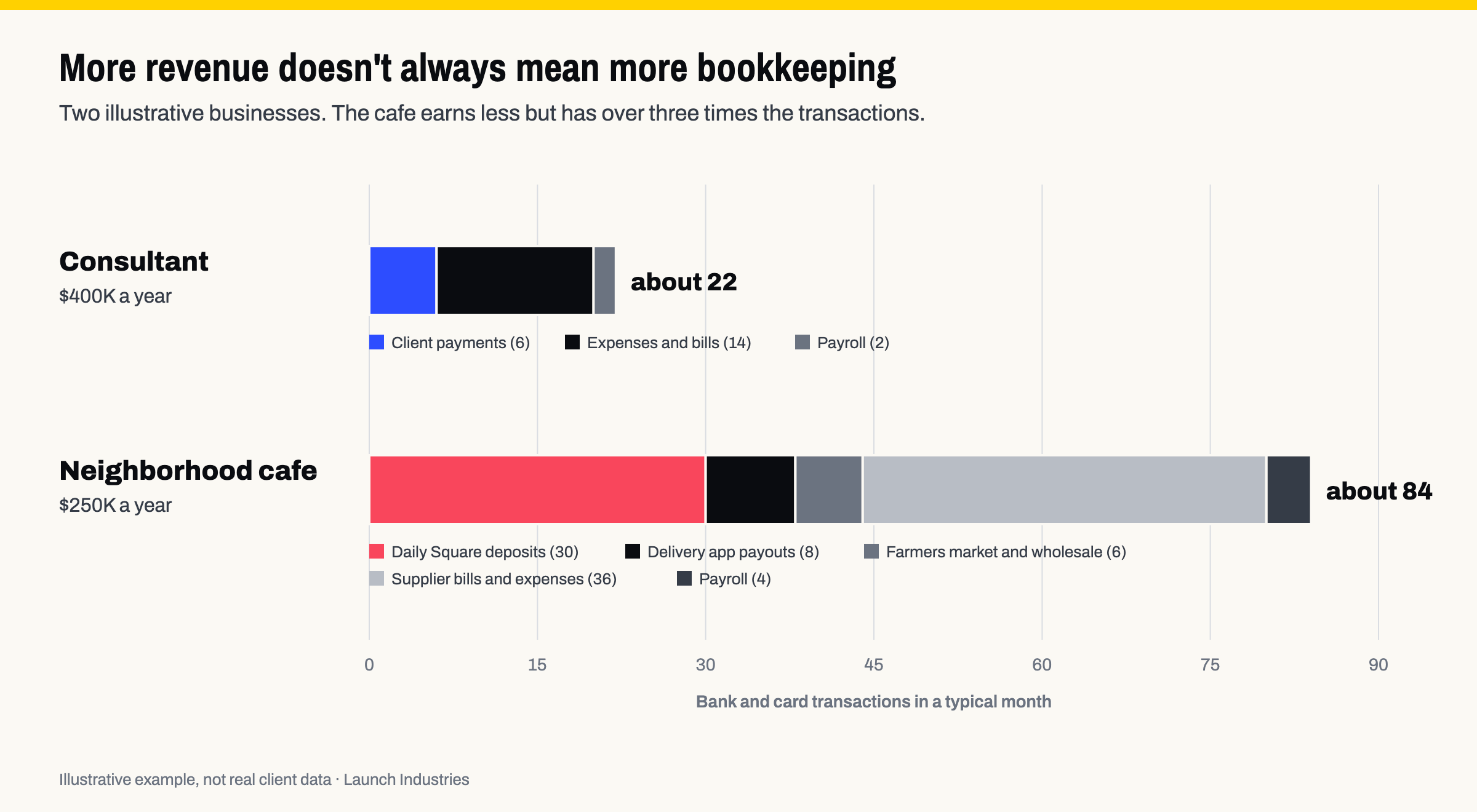
When people size up their bookkeeping needs, they usually start with revenue. That's a reasonable shortcut, and I'll use rough revenue ranges below. But the thing that actually drives bookkeeping work is how many transactions you have and how many places they come from.
One transaction is one line on your bank or credit card statement. A full day of cafe sales that lands as one Square deposit is one transaction, even if 200 customers came through the door. A consultant billing $400,000 a year from six clients might have fewer transactions than a coffee shop doing $250,000 across Square, DoorDash, a farmers market, and a wholesale account.
So as you read the stages below, look at your complexity as much as your revenue: how many bank and card accounts you have, how many ways customers pay you, whether you run payroll, whether you carry inventory, and how many tax filings you owe.
Stage 1: You're just getting started
Roughly: first year in business, or under $100K in revenue
At this stage, most owners can and should do their own bookkeeping. It's the best way to learn how money moves through your business, and the volume is usually small enough to handle in an hour or two a week.
What you need is a good setup and someone to teach you, so you don't build habits you'll pay to undo later. That means:
- QuickBooks Online set up correctly from day one, with a simple chart of accounts that makes sense at tax time
- Bank and card accounts connected, and payment processors like Stripe and Square handled through clearing accounts so your sales and payouts actually match
- A weekly routine for categorizing, and a monthly habit of reconciling
- Knowing your Washington excise tax filings (sales tax and B&O) and when they're due
We built our DIY bookkeeping support for exactly this stage. We set up QuickBooks with you, then meet over your first few months of books to review your work, fix mistakes while they're small, walk through your first excise filing together, and get you ready for year end.
You've outgrown this stage when you're more than a month behind, you skip reconciliations, you've missed a filing deadline, or bookkeeping is taking time you should be spending on customers.
Stage 2: You're steady and growing
Roughly: $100K to $1M in revenue
This is where most businesses should hand off the books. Your time is worth more running the business than categorizing transactions, and the cost of mistakes goes up as the numbers get bigger.
What you need here is full-charge bookkeeping: someone who owns your books every month, start to finish. At Launch, that includes:
- Transactions categorized weekly
- Every bank, credit card, and merchant account reconciled monthly
- Point of sale and online sales reports entered and matched to deposits
- Washington excise and DOR filings prepared and filed on time
- A monthly meeting to walk through your P&L and balance sheet
- Working directly with your tax preparer, so tax season isn't a scramble
One thing we learned the hard way: hourly bookkeeping doesn't work well for this stage. The bill stays invisible until it lands, and a hard month for your business (year-end, a busy season, a messy quarter) turns into a hard month for your bill too. That's why our managed bookkeeping is a flat monthly price based on your business: your size, transaction volume, number of accounts, sales channels, and the filings we handle. It starts at $350 a month plus a one-time $150 setup.
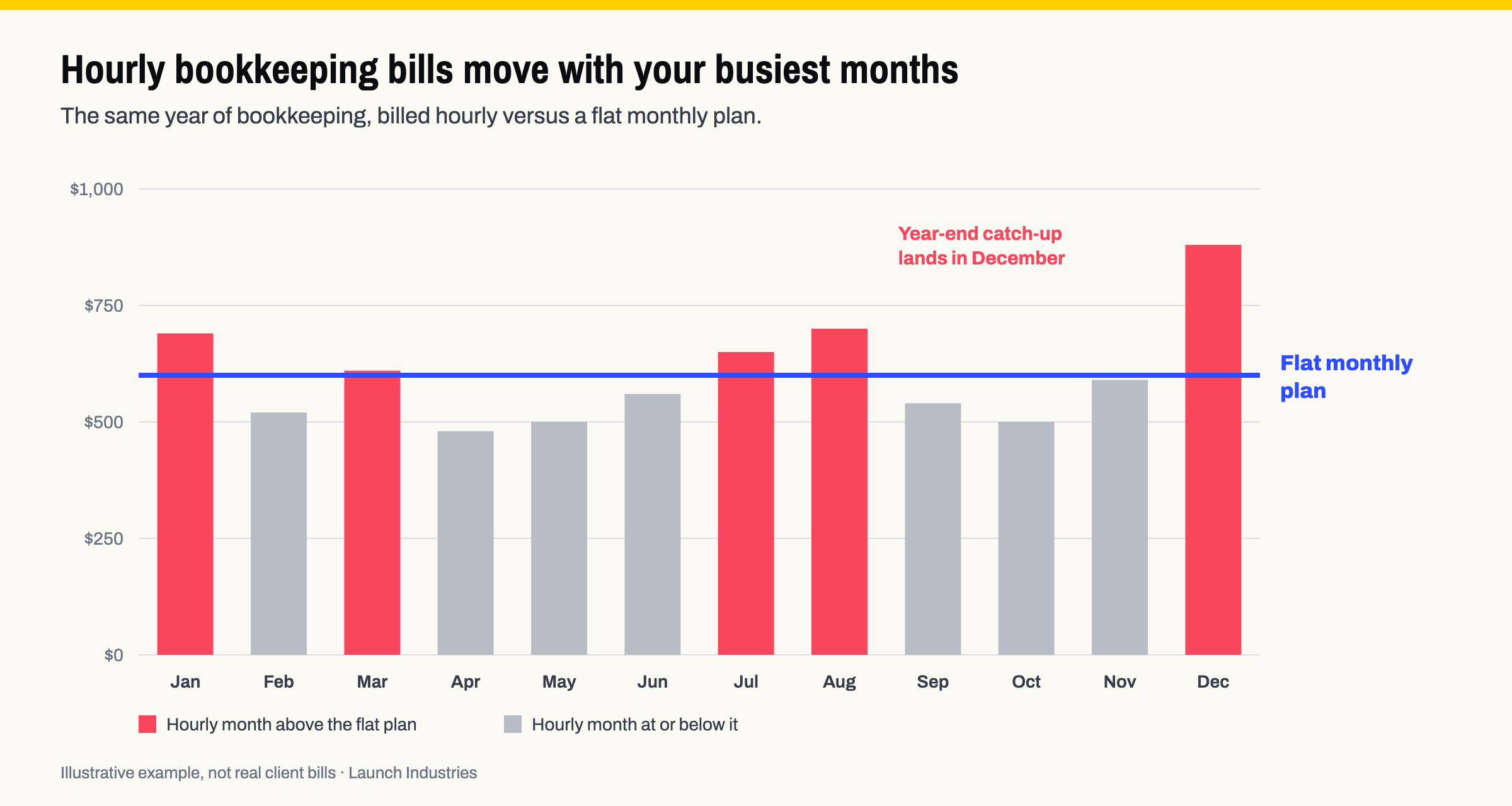
Most owners would rather pay a predictable number every month than wonder what this month's bookkeeping bill will be.
You've outgrown this stage when clean books aren't enough anymore, and you need someone to tell you what the numbers mean and what to do about them.
Stage 3: Your business has real moving parts
Roughly: $1M to $5M in revenue, often with payroll, inventory, or more than one location
At this size, the risk isn't usually that transactions are miscategorized. The risk is that nobody is looking at the whole picture. You need bookkeeping plus oversight: someone experienced reviewing the work each month and turning it into decisions.
That typically adds:
- A monthly review of the books by someone other than the person who did them
- Commentary on what changed from last month and why
- Cash flow forecasting, so you can see a tight month coming before it arrives
- A budget you actually track against
- Payroll oversight, and inventory or job costing set up so you know which products, services, or projects make money
- Basic controls, like making sure the person paying bills isn't also the only one reconciling the bank account
You probably don't need a full-time controller to get this. Most businesses at this stage need a few hours of senior-level attention a month on top of solid bookkeeping.
Stage 4: You're planning big moves
Roughly: $5M and up, or any size when you're raising money
Bookkeeping looks backward: what happened last month. CFO-level work looks forward: what should happen next year, and how you'll pay for it. You need that perspective when you're talking to lenders or investors, buying property or equipment, opening a new location, pricing a big contract, or deciding whether to grow at all.
For most small businesses, a full-time CFO isn't realistic or necessary. Fractional CFO support gives you that judgment for the decisions that need it, without a six-figure salary on your payroll.
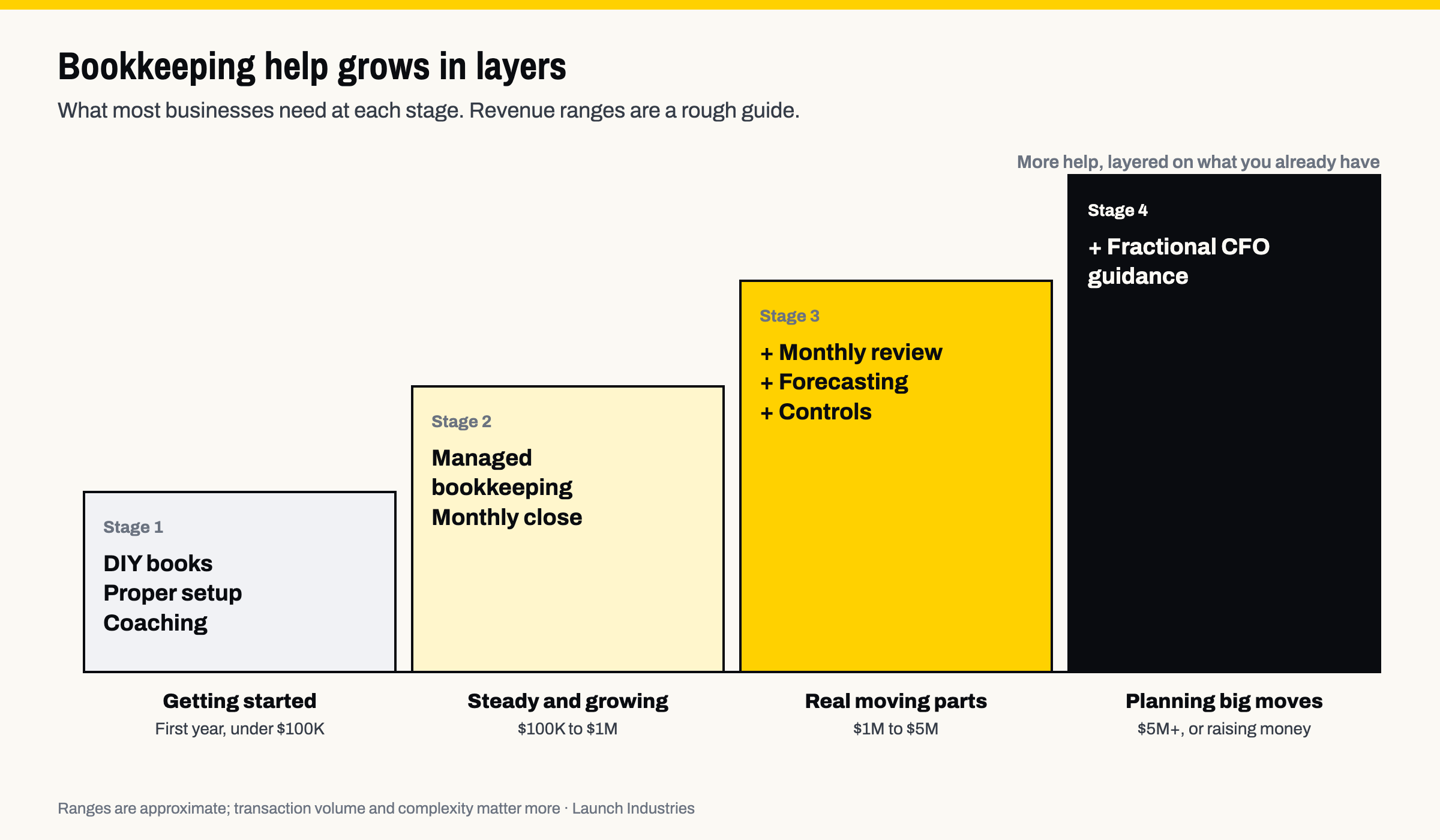
The stages at a glance
| Stage | Rough size | What you need | Time to move up when |
|---|---|---|---|
| Getting started | First year, under $100K | DIY books with a proper setup and coaching | You're a month behind, or missing filings |
| Steady and growing | $100K to $1M | Full-charge managed bookkeeping | You need to know what the numbers mean |
| Real moving parts | $1M to $5M | Bookkeeping plus monthly review, forecasting, and controls | You're raising money or making a big bet |
| Planning big moves | $5M+, or raising capital | Fractional CFO guidance on top of strong books | A full-time finance hire costs less than the outside help |
The mistakes I see most often
Hiring for the title instead of the work
I see owners hire a senior accountant, or a fractional CFO, and then hand that person a stack of uncategorized transactions. You end up paying advisor rates for data entry. Match the level of help to the work you actually have.
Waiting until tax time
Catching up a year of books in March costs more than keeping them current, and the rush makes errors more likely. If you're behind, get caught up first, then get on a monthly rhythm.
Confusing your bookkeeper with your tax preparer
Your bookkeeper keeps your records accurate all year. Your CPA or tax preparer files your annual return. You need both, and the best results come when they work together. We coordinate with your tax preparer, but filing your federal return is their job.
Shopping on hourly rate alone
A cheaper hourly rate with no ceiling can cost more than a flat monthly price. Ask what's included, what isn't, and what happens in a heavy month.
Where to start
If you're not sure which stage you're in, that's normal. Most businesses sit between two of them for a while. We offer a free bookkeeping evaluation where we look at your current setup and tell you honestly what you need. Sometimes that's us, and sometimes it's a better QuickBooks setup and a weekly habit.
You can also get an estimate of your monthly price with the calculator on our Bookkeeping page, or book a call with our team.
Monica Colgan
Founder, Launch Industries