Flat, Tall, or Something in Between? Choosing a Structure That Fits a Small Team
"We're a flat organization" usually means "we haven't drawn the chart yet." Here are the six structures small businesses and nonprofits actually use, what each one costs, and how Launch is really organized.

Ask a small business owner how their company is organized and there is a good chance you will hear "we're pretty flat." It is said with some pride, and often it is true in spirit. Everyone pitches in, titles don't matter much, and the founder's door is open.
But "flat" is not one structure, and it is rarely as flat as it sounds. Every organization has a structure. The only choice is whether you design it or inherit it. This article walks through the options, the tradeoffs, and how we organize Launch.
Six ways to arrange the same people
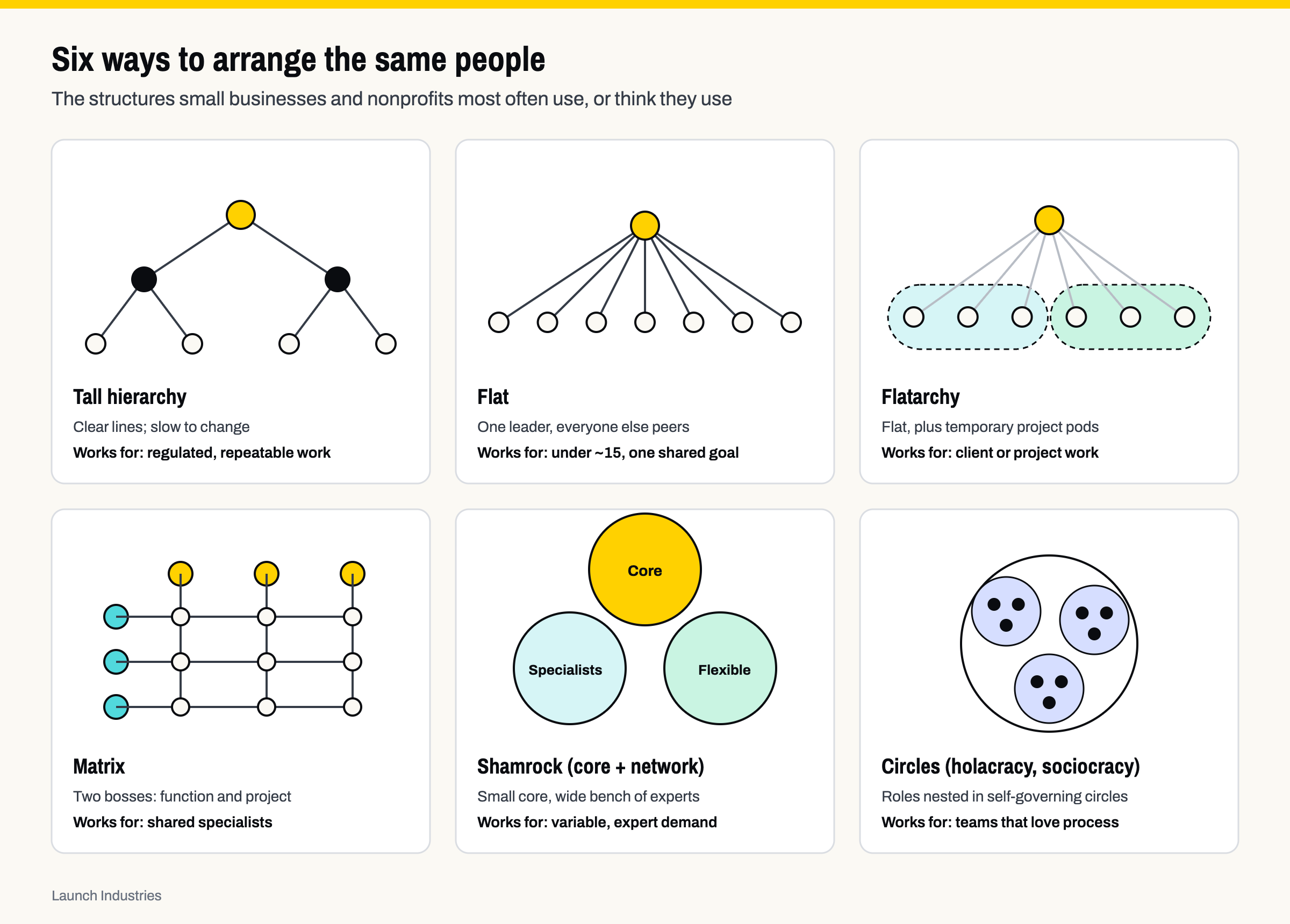
- Tall hierarchy. Several layers of managers, each with a few direct reports. Lines of authority are clear and change is slow. It fits regulated, repeatable work where consistency matters more than speed.
- Flat. One leader, everyone else a peer. Fast and personal. It works best under about fifteen people who share one goal.
- Flatarchy. Mostly flat, with temporary teams that form around a project or client and dissolve when it ends. Common in agencies and consulting firms.
- Matrix. People report to a functional lead (say, finance) and a project or program lead at the same time. It lets scarce specialists serve many projects, at the cost of having two bosses.
- Shamrock. Charles Handy's model from 1989: a small professional core, a "contractual fringe" of outside experts, and a flexible workforce brought in as needed. It fits organizations with uneven demand for specialized skills.
- Circles. Holacracy and sociocracy replace job titles with roles grouped into self-governing circles, each with formal rules for making decisions. They work for teams that genuinely enjoy process.
Flatter means wider, and someone has to hold the width
Flattening an organization doesn't remove management work. It moves it. Fewer layers means each manager has more direct reports, which is called span of control.

A layer of management is a level of people whose job includes managing others. Take an organization of 24 people. If nobody manages more than three people, you need three layers: the owner, two managers, and six supervisors. If each manager runs a team of about five, you need two layers. A truly flat structure means one layer, and one person with 23 direct reports.
Both ends of that range hurt someone. It is just a different someone.
Too tall, and the people closest to the work suffer. Frontline staff wait for approvals from two or three levels up, and information gets filtered on its way up and back down. Managers with only two or three reports have too little managing to do, so they tend to hover over work their people could handle alone. Clients feel it as slow answers. The cost lands on payroll too, because every layer is a salary that does not serve a client. And the owner at the top hears about problems late, if at all.
Too flat, and the leader suffers first, then everyone waiting on them. Nobody can coach, review, and unblock 23 people well. Decisions queue up behind one inbox, and the leader burns out trying to keep up. Staff feel it as little feedback, no clear path to grow, and new hires left to figure things out on their own. Clients feel it when their question sits in that same queue. Eventually informal leaders step in to fill the gap, which is the hidden hierarchy in the next section.
The middle is not perfect, but it spreads the load: each manager has a team small enough to know well and big enough to be worth managing. Research on spans of control points to roughly five to ten direct reports for most managers, fewer when the work is varied and the people are new, more when the work is routine and the team is experienced.
Every flat team has a hierarchy. The question is whether you can see it.
In 1972, the feminist organizer Jo Freeman wrote an essay called "The Tyranny of Structurelessness." Her point was that groups without formal structure do not end up without structure. They end up with an informal one, usually based on friendship, tenure, or confidence, and that hidden hierarchy is harder to question because officially it doesn't exist.
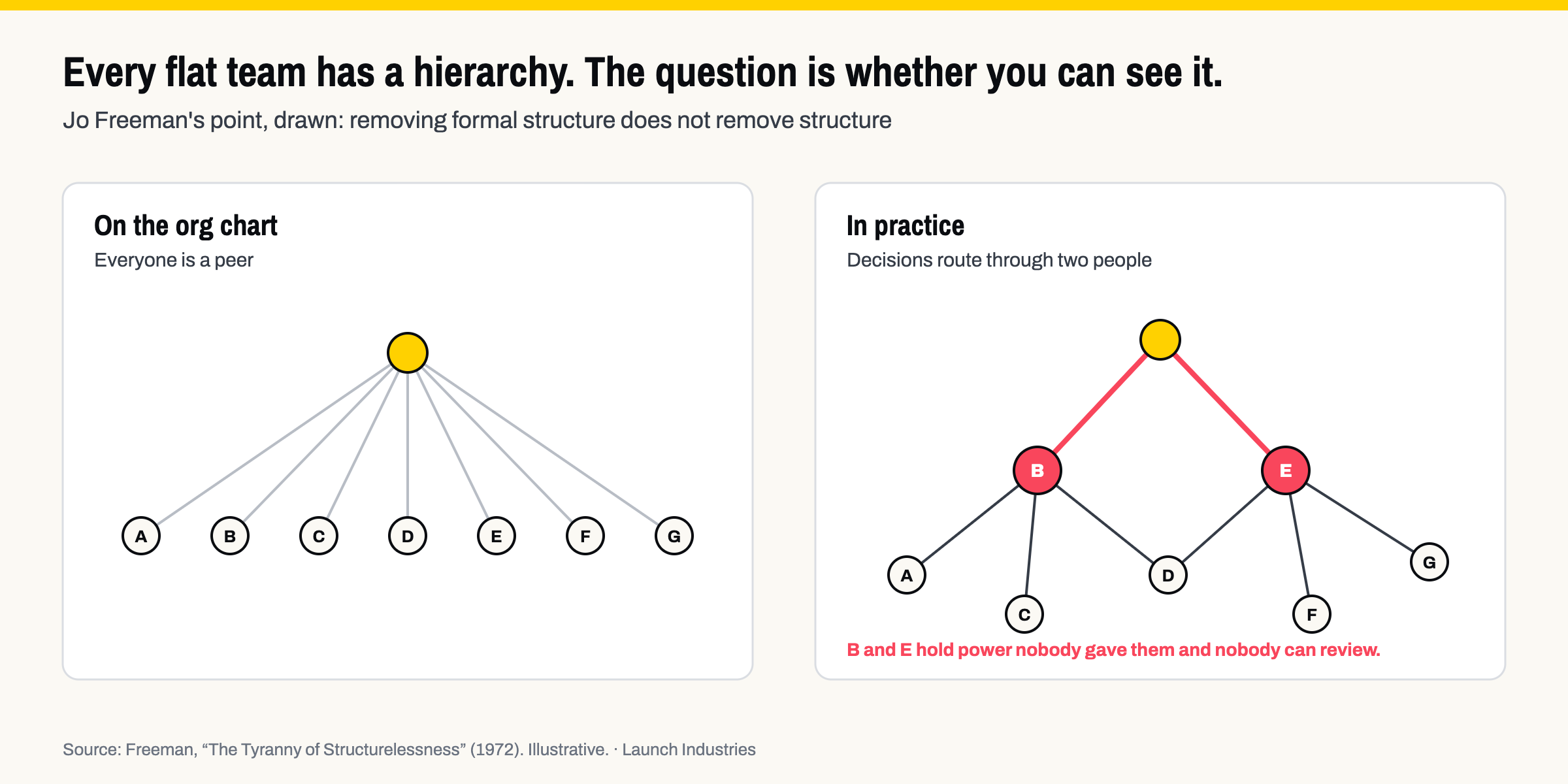
OD practitioners see this pattern often. On paper everyone reports to the founder. In practice, two long-tenured people have become the hubs every decision passes through. They hold real power that nobody granted and nobody can review. These are usually good people doing their best, and they are often exhausted. Making the hierarchy visible, naming who decides what, is kinder to them as well.
The most famous attempt to go fully flat at scale shows how hard this is. When Zappos adopted holacracy in 2015, CEO Tony Hsieh offered employees a buyout if they didn't want to work under the new system. About 14 percent took it in the first round, and by early 2016 about 18 percent of the company had left. Self-management can work, but it takes more structure than a hierarchy, not less.
How Launch is actually organized
We describe Launch as flat. When we pulled our own roster, client assignments, and program staffing to draw this chart, we found that is only true at the top.

 Click the chart to see the peopleClick the chart to see the structure
Our team is 12 employees, including the founder, plus 52 independent contractors and specialists subcontracted through partner firms, working from seven countries. Every role reports to the founder. That part really is flat.
Direct client work runs in light layers. Each client has a Client Success Manager as their main contact. Project managers run the client's projects, and specialists do the hands-on work. The teams are small: most clients work with one or two people, so one person often covers more than one layer.
Our technical assistance programs run the same layers at a larger scale. For government contracts such as Sacramento's CORE program, the Long Beach Social Equity Cannabis Program, and Sound Transit's small business program, the layers are formal: a program management team, consultants who each carry a caseload of 10 to 50 participants, and specialists brought in when a participant needs deeper expertise. On some contracts there is a fourth layer above us, because Launch is the technical assistance provider working under a prime contractor.
Both sides draw on the same functional areas. Every specialist has a home in one of 13 areas: bookkeeping, payroll and benefits, human resources, organization development, operations, finance, RFPs and grants, marketing, branding, websites, our AI Lab, startup support, and registered agent services. A client team and a city program pull from the same pool, which is how a small firm can offer the depth of a much larger one.
Nobody sat down and designed the difference between the two sides. It grew because the work asked for it. A small business owner wants one person who knows them and can pull in help fast. A city contract needs named roles, a clear escalation path, monthly reporting, and someone accountable for every participant. Same layers, very different weight. This is the most useful lesson we have taken from our own chart: structure follows the contract. Look at what each kind of work demands, and let different parts of your organization be organized differently, on purpose.
One design choice holds it together. Teams are tags, not boxes. In our systems a person carries as many team tags as they need, and several of our employees belong to more than ten teams at once: a service line, a handful of client teams, and two or three city programs. Our job descriptions say it plainly: we want people who refuse to be boxed into a single department. A traditional org chart forces each person into one box, which is not how a small, multi-skilled team works.
Our structure has costs, too. Every role reporting to the founder is exactly the span-of-control risk shown earlier, and the founder also manages several programs directly. Our answers so far have been a second program lead who owns a share of the contracts end to end, Client Success Managers who are each client's first stop, and a written decision log so work does not stall while it waits for one person.
A rough guide to picking a structure
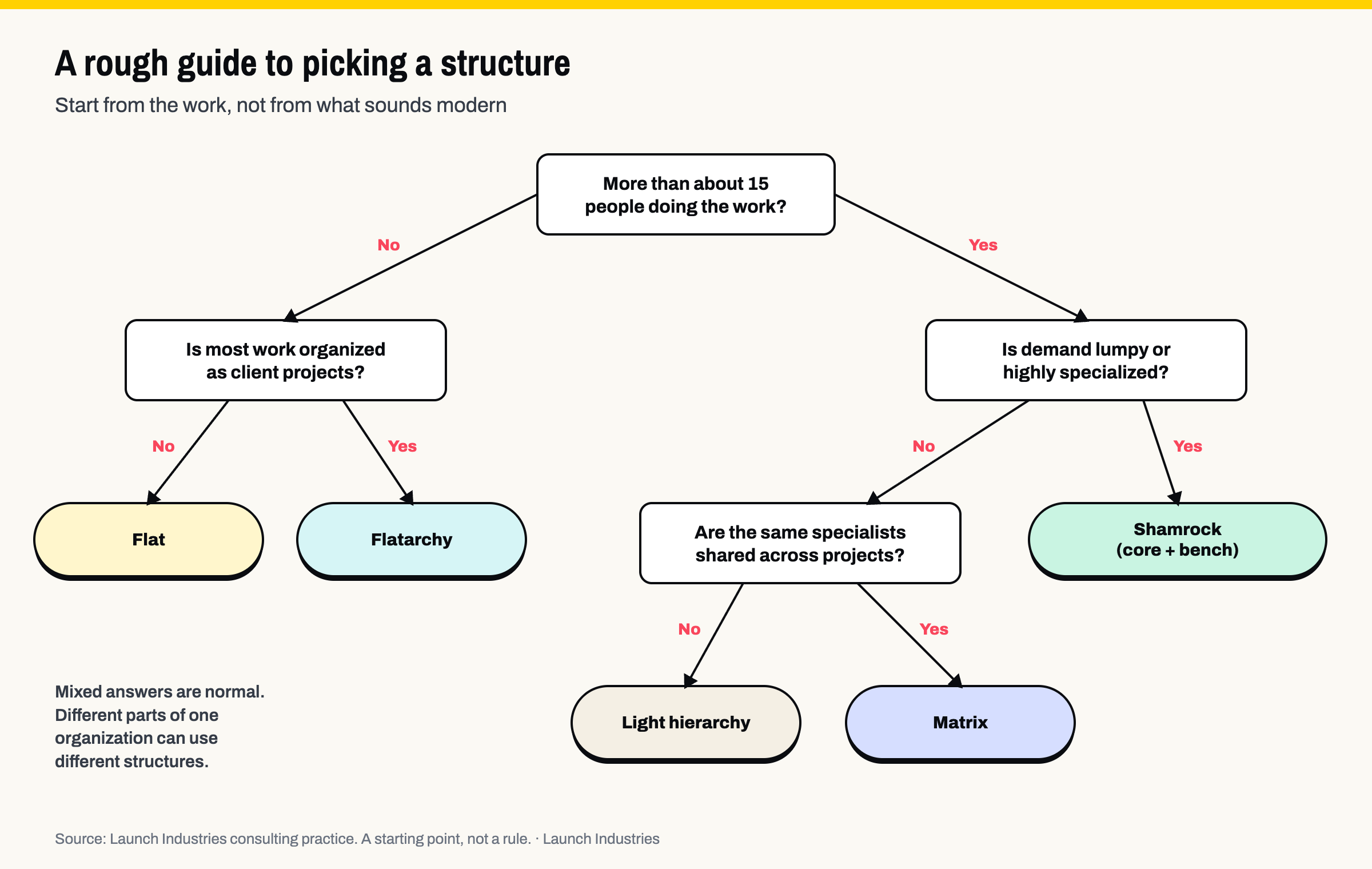
Start from the work, not from what sounds modern. If you are under fifteen people and share one goal, flat is fine; add temporary project pods if your work comes in projects. Past fifteen, ask whether your demand is uneven or highly specialized. If it is, a core plus a bench of experts will usually serve you better than hiring everyone full time. If specialists are shared across projects, you are probably already running a matrix, so make the two reporting lines explicit.
Mixed answers are normal. The most useful idea here for OD practitioners is that structure is a portfolio, not a single choice. Different parts of one organization can, and often should, run different structures. At Launch, the top is flat, client work runs in light layers, our programs run as a formal three-layer hierarchy, and our contractor bench works like Handy's contractual fringe. Each fits the work it does.
A note for nonprofits
Nonprofits are almost always running two structures at once: a board that governs and a staff that operates. Volunteers often act like Handy's flexible workforce, with real commitment but no formal reporting line. Most of the conflict we see in small nonprofits sits at those boundaries. A clear, written agreement about which decisions belong to the board, which belong to the executive director, and how volunteers are supported will prevent more problems than any reorganization.
Learn more about each structure
If you want to go deeper on any of these, these are the resources we point clients to. Most are short reads.
- Tall vs. flat, the basics: Flat vs. Hierarchical Organizational Structure (Chron Small Business) and Hierarchical organization (Wikipedia).
- Flat and flatarchy: Flat Organizational Structure: How to Assess Fit and Avoid Common Pitfalls (Workhuman) and Flat organization (Wikipedia).
- Matrix: Problems of Matrix Organizations by Stanley Davis and Paul Lawrence (Harvard Business Review, 1978), still the classic on why matrices are hard, and Matrix management (Wikipedia).
- Shamrock: The Shamrock Organisation (London Business School, where Charles Handy taught) and Shamrock organization (Wikipedia).
- Holacracy: The Holacracy Constitution (HolacracyOne), the actual rulebook, and Holacracy (Wikipedia) for an overview that includes the criticism.
- Sociocracy: Sociocracy For All, a nonprofit with free monthly intro webinars, and Sociocracy (Wikipedia).
- Span of control: How to identify the right spans of control for your organization (McKinsey), which sorts managers into types with typical ranges of direct reports.
- Hidden hierarchies: The Tyranny of Structurelessness by Jo Freeman, the full essay on the author's own site.
- Growth stages: Evolution and Revolution as Organizations Grow by Larry Greiner (Harvard Business Review).
The takeaway
There is no best structure, only a better fit for your work, your size, and your stage. The one structure that consistently fails is the invisible one. Draw your organization as it really works, compare that with how you describe it, and close the gap on purpose.
If you'd like a second set of eyes, our Organization Development team helps small businesses and nonprofits design structures that fit. For a quick first step, start with role clarity: What Is a RACI Matrix?
Sources: Handy, The Age of Unreason (1989); Freeman, "The Tyranny of Structurelessness" (1972); reporting on Zappos and holacracy in TIME (January 2016) and HR Dive (2016).