What Seattle nonprofits get from the free ABC Program
We looked back at every hour Launch spent with nonprofits in Seattle's ABC Program this year. Here is what they used free consulting for, and how your nonprofit can apply.

If you run a nonprofit in Seattle, the City will pay for real consulting time to help you get your house in order. The Accounting & Business Consulting (ABC) Program, run by the Office of Economic Development, gives eligible organizations up to 40 free hours across four areas: business development, accounting and bookkeeping, marketing and branding, and loan support.
Launch Industries is one of the program's consulting firms, and we work in the business development category. This year we looked back at every hour we spent with nonprofits in the program to answer a simple question: what do nonprofits actually use this help for? Here is what we found, so you can picture what your organization could get out of it.
What we looked at
Between January and October 2026, we worked with 11 nonprofits through ABC: community coalitions, cultural and community-service organizations, environmental and food groups, arts organizations, and neighborhood alliances. Together that came to just over 53 hours of consulting from our team. Some organizations used a short check-in. Others used close to their full allotment on one project.
The numbers below cover the business development work Launch delivered. Accounting, marketing, and loan support come from the program's other consulting firms, so they are not counted here.
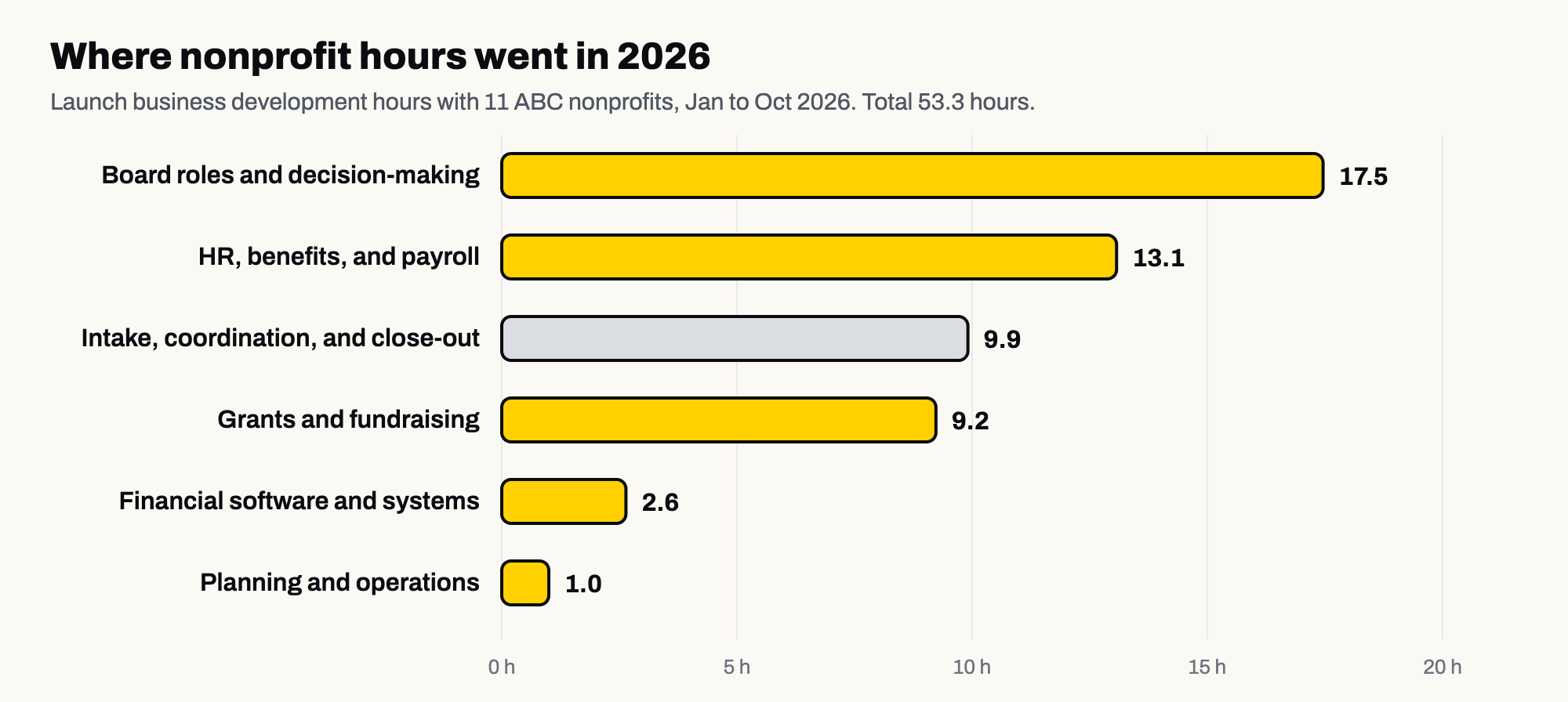
Board roles and decision-making
The biggest single use of hours was helping a growing coalition sort out who decides what. As more partners joined, the organization had decisions stuck between staff, partners, and the board. We built a responsibility matrix (who is responsible, who approves, who is consulted, who is informed), drafted a decision-making framework, and designed and facilitated a board meeting focused on role clarity. Afterward we ran a short survey so board members could weigh in on approval criteria, then wrote up the results so the board had something concrete to vote on.
If your board meetings keep circling the same questions, or your staff are not sure what they can approve on their own, this is the kind of work the program covers.
HR, benefits, and payroll
Three nonprofits used their hours on people operations. The work included:
- Reviewing an older employee handbook against Washington and Seattle law taking effect January 1, 2027, with a full redline and a list of changes
- Walking through health insurance options and the employee census an insurer asks for, including how Medicare interacts with employer coverage
- Comparing retirement plan options for a small team
- Reviewing a payroll setup end to end, from timesheets to benefits deductions to how payroll connects with the accounting software
Small nonprofits often have one person carrying HR on top of a full job. A few focused sessions can close compliance gaps before they turn into penalties.
Example: a neighborhood senior center
One senior center came to us in September with its employee handbook and its benefits both overdue for attention. Over about six hours across five weeks, our HR consultant:
- Met with the center's leadership to review the employee handbook and talk through the policy decisions it raised
- Set up the employee census its health insurance pool required, then worked through the forms with staff until they were complete
- Explained how Medicare works alongside employer health coverage, a real question for an organization with older employees
- Laid out the 401(k) options a team its size could realistically offer
- Reviewed how benefits and retirement contributions were set up in its payroll system, and checked its payroll tax accounts
The work wrapped up in mid-October, inside the hours the program provides.
Grants and fundraising
Two organizations came to us with funding on the line. One had a City grant application due soon. A grant consultant on our team reviewed the narrative and budget, made tracked comments, and met with the applicant to go through them before the deadline. The other wanted to grow its funding base, so we drafted a fundraising strategy deck with a framework, suggested copy, and the metrics to track, along with a draft press release backed by national data.
Financial software and systems
Several nonprofits needed their tools to work together. We ran a QuickBooks training session, reviewed how payroll software connects to the accounting file, and put together a comparison of software built for nonprofits. For one organization we also set up a shared folder system and a secure sheet for company information and logins, so nothing lived in just one person's inbox.
Planning and operations
Some organizations wanted a sounding board for the year ahead. In one case we reviewed the organization's finances and revenue trends ahead of a planning call, then talked through priorities for 2026 and how to manage the grants it already had.
What the first and last hours are for
Every engagement starts with an intake meeting where we learn about your organization and agree on what success looks like for your hours. At the end, we check in, close out the work, and make sure you have every document we produced. A little under a fifth of our nonprofit hours this year went to that intake, coordination, and close-out. It is part of the service, and it keeps the remaining hours focused on what matters most to you.
Is your nonprofit eligible?
Nonprofits have taken part this year on the same terms as small businesses. The program's baseline requirements are:
- A valid City of Seattle business license with a Seattle address
- At least two of these three: gross annual revenue of $5 million or less, 50 or fewer full-time employees, or two or fewer brick-and-mortar locations
A few things to know before you apply:
- You can receive up to 10 hours in each of the four categories, for up to 40 hours in total.
- The Office of Economic Development reviews every application and assigns your consultant. You do not choose the firm.
- Hours must be used within six months of starting services, so plan to start when you have time to engage.
- If English is not your first language, the program can connect you with language support.
How to apply
Apply through the City's application at abcapplication.fillout.com/2026abc. Questions about eligibility go to the program team at ABCProgram@seattle.gov.
If you are assigned to Launch, we will start with an intake meeting and build a plan around the part of your operation that needs the most help right now.